
Portable ergonomic relief: improve sitting comfort
Table of Contents
- Understanding portable ergonomic relief for sitting comfort
- How to sit comfortably at a desk with proper support
- Seat cushion for tailbone pain relief
- Memory foam seat cushion selection and use
- Ergonomic cushion for long sitting sessions
- Setting up your workspace for all-day comfort
- Movement breaks and maintenance for sustained comfort
- Frequently Asked Questions
Last Updated: October 13, 2026
Understanding portable ergonomic relief for sitting comfort
Portable ergonomic relief means adding supportive cushions, lumbar supports, and positioning tools to any seat, whether at your desk, in your car, or whilst travelling.
The right portable support can transform a painful workday into one where you can actually focus. The difference isn't always about buying an expensive new chair. Often, it's about layering affordable, practical solutions that move with you.
Long hours of sitting compress your spine and shift weight unevenly. Your tailbone bears pressure that builds over hours. Your lower back flattens instead of maintaining its natural curve.
How to sit comfortably at a desk with proper support
Sitting comfortably starts with three things: your chair height, your monitor position, and what you're sitting on. Get these wrong and no cushion will fully rescue your comfort.

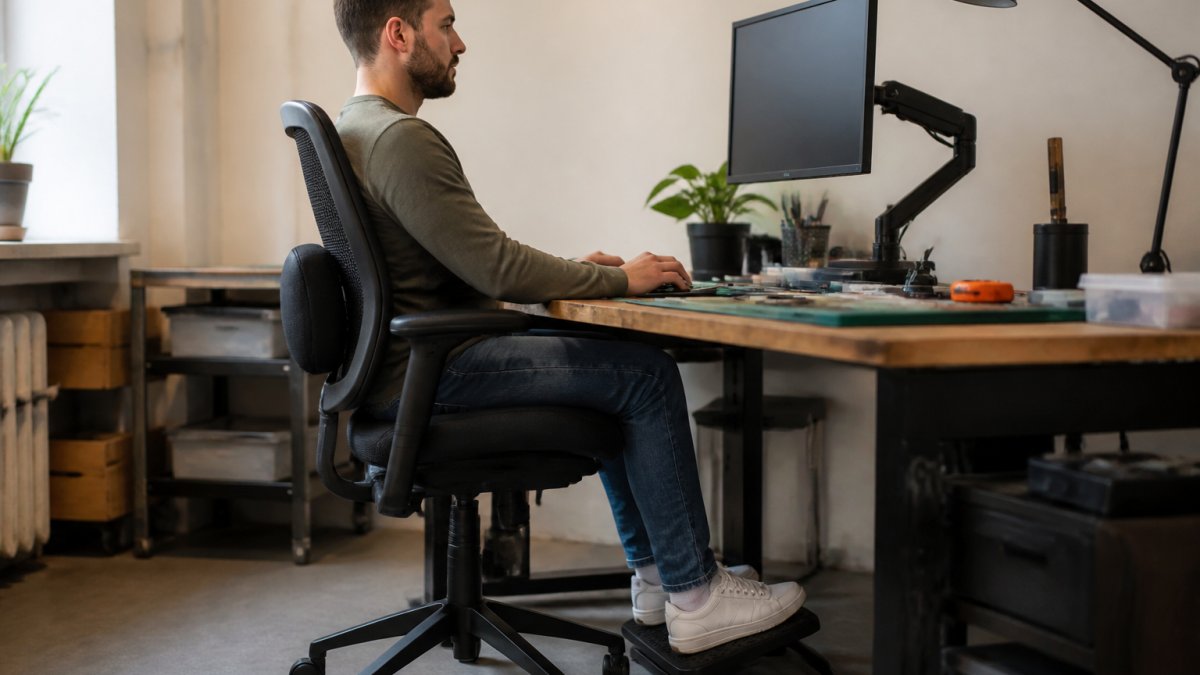
Positioning your chair and monitor
Your chair height should allow your feet to rest flat on the floor or a footrest, with your knees at roughly 90 degrees.
Once your desk setup is positioned correctly, a seat cushion or lumbar support cushion becomes far more effective. The cushion fills gaps between your body and the seat, supporting your sitting position rather than forcing it.
A common mistake is assuming that a cushion alone fixes poor positioning. It won't. Position first, then add support.
Adding cushioning and support layers
Start with a seat cushion beneath you. The ElevateSupport Memory Foam Seat Cushion (£16.99) provides a softer, more supportive surface for everyday sitting at your desk, in the car, or at home. Its ergonomic shape cushions your sitting position without adding bulk.

Next, add lumbar support behind your lower back. This is where many people feel the most relief, especially if you spend 6+ hours sitting daily.
Together, these two products create a complete support system. The seat cushion addresses pressure on your tailbone and hips. The lumbar support maintains the natural curve of your spine.
Seat cushion for tailbone pain relief
Tailbone pain (coccydynia) develops from sustained pressure on a small, sensitive bone at the base of your spine. Long sitting sessions concentrate weight directly on this area, especially if your chair seat is firm or angled downward.
A properly designed seat cushion relieves this pressure by distributing your weight across a larger surface area. The ElevateSupport Central-Groove Memory Foam Seat Cushion (£22.99) includes an ergonomic central groove that reduces pressure on the tailbone specifically and supports proper spinal alignment.

For tailbone pain, the central groove matters. A flat cushion compresses under your weight. A grooved cushion actively reduces pressure in the most sensitive area.
If you have chronic tailbone pain or have been diagnosed with coccydynia, this targeted design often provides noticeable relief within the first few days of use.
Memory foam seat cushion selection and use
Memory foam works by responding to body heat and pressure. When you sit, the foam softens and contours to your shape, distributing pressure across a wider area instead of concentrating it on bony points. As you shift position, the foam responds and adjusts.
Why memory foam works for long-term comfort
Memory foam's ability to conform to your body is what makes it effective for extended sitting.
The density of the foam matters. Higher-density memory foam provides more support and lasts longer. Lower-density foam is softer but breaks down faster. ElevateSupport products use supportive memory foam designed for everyday durability.
Memory foam also absorbs impact and reduces the shock that travels through your spine during sitting. This is especially valuable if you sit on a hard office chair or car seat.
Portable options for desk, car and travel
The same seat cushion that works at your desk works in your car. The ElevateSupport Memory Foam Seat Cushion is lightweight and portable, you can move it between your office chair, your car seat, and your home seating throughout the week.
For travel, portability is essential. A cushion that weighs under 1kg and fits in a bag makes a real difference on long flights or coach journeys.
If you drive 4+ hours weekly and also work at a desk, having two cushions can eliminate the daily transport hassle.
Ergonomic cushion for long sitting sessions
An ergonomic cushion is shaped to support your body during extended sitting. Unlike a decorative cushion, it has contoured support zones, breathable fabric and materials chosen for durability. But the useful question is not 'is it ergonomic?', it is 'is it right for my body, my seat and how long I sit?'
Choosing by body size, seat type and duration
Use this framework before buying:
- Body size. Heavier users need higher-density foam that resists bottoming out; lighter users often find high-density foam too firm and prefer a medium-density cushion with a contoured shape. If your hips are wider than the seat, a wider cushion prevents pressure at the seat edges.
- Seat type. Firm upright office chairs suit a deeper cushion (around 7-8cm). Soft or reclined car and plane seats suit a slimmer cushion (around 5-6cm) to avoid tilting the pelvis. Hard plastic chairs benefit most from a cushion with a stable, non-slip base.
- Duration. For under two hours, most people notice little difference. For two to four hours, a contoured seat cushion plus a lumbar support covers most needs. Beyond four hours, the priority shifts to pressure redistribution and breathability, because heat and moisture build-up becomes as uncomfortable as pressure.
What a cushion can and cannot do
A cushion can redistribute pressure away from the tailbone and hips, support the natural curve of the lower back when paired with a lumbar support, and reduce the shock transmitted through the spine on hard seats. That is a genuine comfort benefit.
A cushion cannot correct a poorly positioned desk, replace movement breaks, or treat a medical condition. Comfort and treatment are different things.
Features that matter for long sessions
- Contoured support zones. A central groove or cut-out reduces pressure on the tailbone; side contours help keep the hips level.
- Breathable cover. Mesh or moisture-wicking fabric matters more the longer you sit, because trapped heat softens foam and reduces its support.
- Non-slip base. Keeps the cushion stable on smooth car seats and hard chairs.
- Removable, washable cover. Hygiene and durability over months of daily use.
- Density and thickness. Higher density lasts longer; thickness should match the seat as above.
Care, portability and durability trade-offs
Portable supports trade off against each other. Lighter cushions are easier to carry but often use lower-density foam that flattens sooner. Thicker cushions offer more pressure relief but pack less easily. Strap-on lumbar supports stay in place better but add a step to setup.
The practical compromise for most people is a medium-density contoured seat cushion under 1kg with a removable cover, plus a strap-on lumbar support for longer sessions. Follow the care instructions supplied with your cushion, wash covers as directed, and replace foam that has visibly flattened or stopped returning to shape.
Setting up your workspace for all-day comfort
A complete ergonomic workspace includes more than just a cushion. Your feet, arms, and back all need support.
Lumbar support positioning
Your lumbar support cushion should sit at the curve of your lower back, roughly 5-10cm above your hip level. Position it too high and it pushes into your mid-back.
The ElevateSupport Memory Foam Lumbar Support Cushion includes an adjustable strap that holds it in place as you move. Adjust the strap so the cushion stays centred on your lower back without sliding upward or downward.
A properly positioned lumbar support prevents the slouching that develops as you fatigue. Without it, your lower back gradually flattens against the chair, increasing strain on your discs and ligaments.
Footrest and armrest additions
Your feet should rest flat on the floor or on a footrest. If your feet dangle, your leg weight pulls on your lower back. A footrest like the ElevateSupport Memory Foam Footrest (£15.99) provides a soft, supportive surface that reduces strain and improves circulation.
For your arms, hard armrests create pressure points on your elbows and forearms. Over hours, this tension radiates into your shoulders and neck.
Together, seat cushion, lumbar support, footrest, and armrest cushions create a complete ergonomic environment. Each piece addresses a different pressure point.
| Support Element | Purpose | Best For |
|---|---|---|
| Seat cushion | Reduces tailbone and hip pressure | All-day sitting |
| Lumbar support | Maintains lower-back curve | Desk work, driving |
| Footrest | Reduces leg strain | Desk setups |
| Armrest cushions | Relieves elbow pressure | Long desk sessions |
Movement breaks and maintenance for sustained comfort
Even the best cushion cannot replace movement. Your body is designed to move, not to sit for 8 hours straight.
Stand and walk for 2-3 minutes every hour. Stretch your hip flexors, lower back, and neck.
Cushion maintenance is straightforward. Most ElevateSupport cushions have removable, washable covers.
Portable ergonomic relief works because it addresses the specific pressures that develop during long sitting sessions. A seat cushion alone helps.
ElevateSupport products are designed around this principle. Each item works independently, but they work better together.
Frequently Asked Questions
Can I use the same memory foam seat cushion at my desk and in my car?
Yes. Many memory foam seat cushions are designed for multiple environments. The Memory Foam Seat Cushion (£16.99) and Memory Foam Lumbar Support Cushion (£17.99) are both lightweight and portable, making them easy to move between your office chair and car seat. The adjustable strap on the lumbar cushion helps keep it positioned securely in both locations. Simply place the cushion on your seat before sitting, and remove it when you leave. This versatility makes a single cushion a practical investment for both home office and commuting.
How long does memory foam last before it starts to flatten?
Quality memory foam cushions maintain their support for extended periods with proper care. The durability depends on the density and thickness of the foam and how frequently you use it. To extend the life of your cushion, follow the care instructions provided with your product, avoid exposing it to extreme heat, and allow it to fully decompress between uses. Premium memory foam cushions can remain supportive for an extended period of daily use. Rotating the cushion occasionally and using a removable, washable cover helps preserve its condition.
What should I look for in a portable ergonomic seat cushion?
Choose a cushion based on your primary pain point, sitting environment, and portability needs. For tailbone pressure, look for a central-groove design like the Central-Groove Memory Foam Seat Cushion (£22.99), which reduces pressure on the tailbone and supports spinal alignment. For lower-back support, a contoured lumbar cushion with an adjustable strap (£17.99-£29.99) works best. Check that the cushion is lightweight, has a non-slip base, and fits your chair or car seat dimensions. Breathable fabric covers help prevent heat buildup during long sitting sessions. Consider whether you need portability between multiple locations, as this may influence your choice.
Can a seat cushion actually improve my posture?
A quality ergonomic cushion supports better posture by encouraging proper spinal alignment and reducing discomfort that causes slouching. When your lower back and tailbone are properly supported, your spine naturally aligns better, and you're less likely to shift into poor positions to relieve pressure. Cushions with contoured lumbar support or central grooves actively encourage upright sitting. However, a cushion works best as part of a complete setup: pair it with correct monitor height, keyboard position, and regular movement breaks. The cushion removes the distraction of discomfort, making it easier to maintain good posture throughout your workday.