
Best Seat Cushion for Desk Chair: 2026 Comfort Guide
Table of Contents
- How to Choose a Seat Cushion for Office Chair
- Memory Foam vs Gel Seat Cushion: Which Works Better?
- Ergonomic Seat Cushion for Back Pain: Pressure Relief and Tailbone Support
- Breathability, Temperature Control and Non-Slip Base
- Integration with Existing Ergonomic Chairs
- Cleaning, Maintenance and Washable Cover Instructions
- Frequently Asked Questions
Last Updated: September 21, 2026
How to Choose a Seat Cushion for Office Chair
Finding the best seat cushion for desk chair use starts with three measurements: your body weight, your chair's seat depth, and how many hours you sit each day. Most people buy on comfort alone and end up replacing the cushion within months. This guide from ElevateSupport walks through the factors that actually predict whether a cushion will still support you a year from now.
The stakes are real. The Health and Safety Executive guidance on display screen equipment requires employers to assess workstation seating because prolonged static sitting contributes to musculoskeletal problems. A seat cushion is not a substitute for a properly adjusted chair, but the right one changes how pressure is distributed across your hips and thighs.
Here is what matters most:
- Density over squish. High-density foam holds its shape; soft foam collapses under repeated load.
- Thickness matched to seat depth. Too thick and your knees sit above your hips, tilting the pelvis backward.
- A non-slip base. A cushion that slides forward every hour is worse than no cushion.
Below, we break down density, weight limits, and the memory foam versus gel question so you can choose once and choose well.
Key Factors: Density, Thickness and Seat Depth
Cushion density is the single best predictor of lifespan. High-density foam resists compression, which means it keeps supporting your sit bones after months of daily use.
Thickness should follow your seat depth, not your preference for plushness. A cushion that is too deep pushes your knees higher than your hips and reverses the pelvic tilt you are trying to correct. As a rule of thumb, aim for a cushion that leaves two to three fingers of space between the back of your knee and the cushion edge.
- Under 5 cm: minimal lift, best for shallow seats or low desks
- 5 to 8 cm: the practical middle ground for most office chairs
- Over 8 cm: only for users who need significant height, and usually paired with a footrest
Weight Capacity and BMI-Specific Recommendations
Weight capacity is the specification most buyers never check, and it is the reason cushions fail early. Standard memory foam compresses permanently under sustained heavier loads, so a cushion rated for lighter users will flatten quickly for someone above that threshold.
Check the stated maximum load before buying, and treat it as a hard limit rather than a guide. If you are near the upper end of a cushion's range, choose a denser foam or a model with a firmer base layer. The same logic applies to BMI: higher body mass increases peak pressure at the sit bones, so a cushion needs more density, not more thickness, to manage pressure distribution.
Memory Foam vs Gel Seat Cushion: Which Works Better?
Memory foam wins for posture support and shape retention; gel wins for immediate cooling. That is the honest summary, and it explains why many ergonomic designs combine both.
Memory foam moulds to your shape and spreads load across a wider area, which is why it suits long sitting hours. Its weakness is heat retention. Gel-infused layers address that by drawing warmth away from contact points, but gel on its own offers less contouring and can feel firm at first.
| Feature | Memory Foam | Gel |
|---|---|---|
| Pressure distribution | Excellent contouring | Moderate, firmer feel |
| Temperature regulation | Retains heat unless gel-infused | Cools well |
| Shape retention | Good in high-density grades | Good, resists compression |
| Best for | Posture support, all-day desk use | Warm offices, short sessions |
Shape Retention and Long-Term Material Degradation
Shape retention depends on foam density and how the cushion is used, not on the brand name printed on the label. A high-density cushion used for six hours a day will typically hold its structure far longer than a low-density one used the same way.
Degradation shows up in stages. First the cushion stays compressed after you stand. Then the front edge softens and stops supporting your thighs. Finally the surface develops permanent dips where your sit bones rest. Once a cushion no longer springs back within a few seconds, it has stopped doing its job.
Ergonomic Seat Cushion for Back Pain: Pressure Relief and Tailbone Support
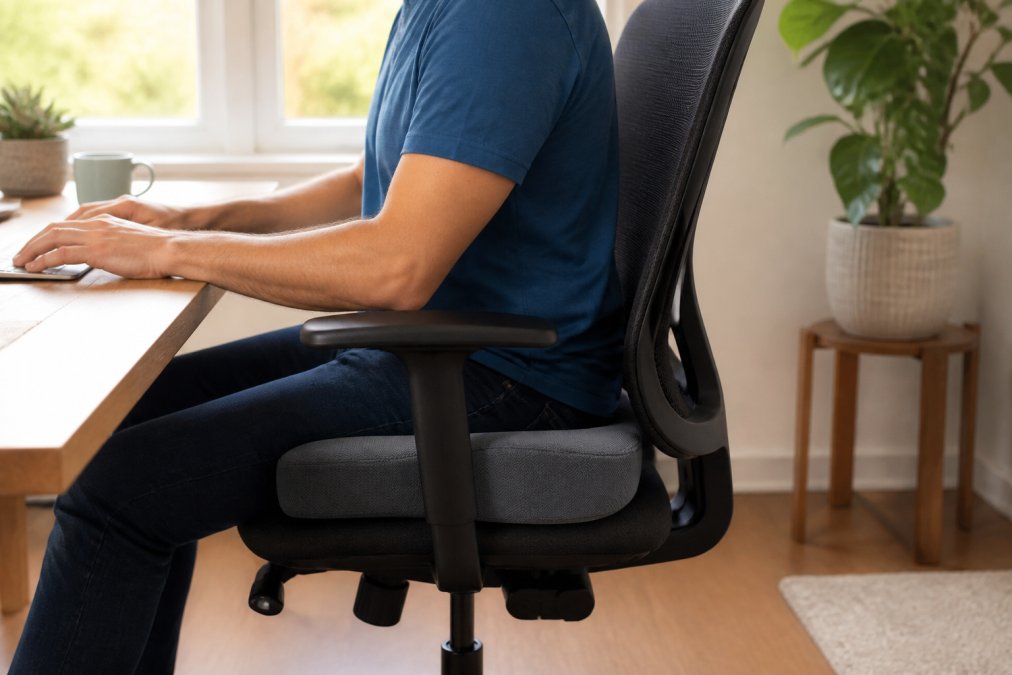
An ergonomic seat cushion for back pain works by redistributing load away from the tailbone and sit bones, which reduces the peak pressure that drives discomfort during long sitting hours. The design detail that matters most is a cut-out or contoured channel at the rear.
That cut-out matters because the coccyx sits at the very back of the pelvis. A flat cushion presses directly on it. A coccyx relief channel suspends the tailbone over empty space, so body weight travels through the thighs and buttocks instead. Combined with a slight wedge, this also encourages a neutral pelvic tilt and better spinal alignment.
Medical Condition Specificity: Sciatica, Coccyx Relief and Pelvic Tilt
Different conditions need different cushion geometry, and treating them as one problem is where most advice falls short. A cushion that helps a bruised tailbone may do little for sciatic nerve irritation.
- Coccyx pain: prioritise a deep rear cut-out and medium-firm density to keep direct pressure off the tailbone.
- Sciatica: look for even pressure distribution across the whole seat, since uneven loading can aggravate nerve compression through the buttock.
- Pelvic tilt issues: a gentle wedge that raises the back of the seat encourages the pelvis forward into a neutral position.
If your pain is diagnosed and persistent, treat the cushion as one part of a wider ergonomic assessment involving your chair height, desk level, and movement breaks. A cushion manages pressure; it does not replace clinical advice.
Breathability, Temperature Control and Non-Slip Base
Breathability decides whether you actually keep using a cushion through a full working day. Foam that traps heat makes you shift constantly, and constant shifting undoes the pressure relief you bought the cushion for.
Look for a breathable mesh cover over a gel-infused or perforated foam core. The mesh lets air move between you and the foam, while the perforations give heat somewhere to escape. Temperature regulation is the reason gel-infused memory foam has become the default in this category.
The base matters just as much. A non-slip base with a textured underside grips the chair rather than your trousers, so the cushion stays where you placed it. Without it, you will be repositioning the cushion every twenty minutes, which is its own source of sitting fatigue.
Integration with Existing Ergonomic Chairs
A seat cushion should complement your chair, not fight it. Most ergonomic chairs are already shaped to support the pelvis, and adding the wrong cushion can flatten that contour or push you out of position.
Check three things before adding a cushion to a chair you already like.
Cleaning, Maintenance and Washable Cover Instructions
A washable cover is not a luxury feature; it is what keeps a cushion hygienic through daily use. Foam cores cannot be machine washed, so the cover does all the work.
Follow this routine:
- Unzip and remove the cover weekly
- Machine wash the cover at 30°C on a gentle cycle
- Air dry flat, away from direct heat
- Vacuum the foam core with a brush attachment monthly
- Spot clean spills immediately with a damp cloth and mild soap
- Never submerge the foam core in water
Frequently Asked Questions
How can I make my desk chair more comfortable without buying a new one?
A supportive seat cushion is the simplest upgrade. Look for a high-density memory foam or gel-infused cushion with a non-slip base and a washable cover. It adds pressure distribution where your chair lacks it, improves spinal alignment and reduces sitting fatigue. For long sitting hours, pair it with a lumbar support and adjust your seat depth so your feet stay flat on the floor.
Are gel-infused seat cushions better than standard foam?
It depends on your priorities. Gel-infused cushions disperse heat better, which helps with temperature regulation during long sitting hours. Standard memory foam offers more contouring and pressure relief for tailbone pain, but can retain warmth. High-density foam with a breathable mesh cover often balances both. For desk work, a memory foam vs gel seat cushion decision usually comes down to whether you overheat or need deeper coccyx relief.
How often should you replace your desk chair seat cushion?
Most quality memory foam cushions last 12 to 24 months with daily use. Replace yours when the foam stops springing back, develops flat spots or no longer supports your posture. Cheaper foams degrade in six months, while high-density foam holds shape retention longer. A washable cover extends hygiene, but the foam core determines lifespan. If you notice increased tailbone pain or sitting fatigue, the cushion has likely lost its supportive padding.
Do seat cushions actually help with back pain while working?
Yes, when chosen correctly. An ergonomic seat cushion for back pain works by redistributing pressure away from the tailbone and sciatic nerve, encouraging pelvic tilt and spinal alignment. It does not replace an ergonomic assessment or lumbar support, but it reduces pressure points during long sitting hours. For chronic conditions like sciatica, look for orthopedic design with coccyx relief and check the firmness level suits your weight.
Sitting for long hours puts steady pressure on the same points, and a cushion that flattens or slides makes that worse rather than better. ElevateSupport builds comfort-focused ergonomic products around premium memory foam, designed for work, home, gaming, and travel, with free delivery on orders of £50 or more. If you want support that holds its shape through a full working day, browse the ElevateSupport range and shop comfort with confidence.