
5 Best Lumbar Support Pillows for Chairs
Table of Contents
- What to Look for in a Lumbar Support Pillow
- Benefits of Lumbar Support for Posture and Comfort
- Quick Comparison Table
- Best Lumbar Support Pillows: Our Top 5 Picks
- Best Seat Cushion for Desk Chair: Finding Your Match
- Durability, Compatibility, and Long-Term Value
- Frequently Asked Questions
Last Updated: September 30, 2026
What to Look for in a Lumbar Support Pillow
When choosing a lumbar support pillow, the most important consideration is how well it matches your specific seating environment and sitting duration. The fit matters more than the brand name.

Assess three key factors: material density, attachment mechanism, and contoured shape. High-density memory foam provides firmer support for sustained sitting, whilst softer foam prioritises immediate comfort but compresses faster with heavy daily use.
The attachment method determines whether your cushion stays in place. Look for adjustable straps that secure firmly without slipping, preventing constant readjustment throughout the day.
Examine the contoured shape. A well-designed lumbar support pillow mirrors your spine's natural curve, supporting pelvic tilt and reducing sciatic nerve strain.
The best lumbar support pillows balance firmness with breathability. Breathable fabric prevents heat buildup during extended sitting, and a washable cover ensures long-term hygiene and durability.
Benefits of Lumbar Support for Posture and Comfort
Proper lumbar support addresses prolonged sitting fatigue by maintaining spinal alignment, counteracting the forward rounding that stresses lower back muscles and vertebrae.

Correct posture reduces pressure on vertebral discs, meaning less strain accumulates over time and fewer end-of-day aches.
For those managing sciatica or lower back pain, lumbar support pillows reduce nerve compression and muscle tension. Consistent support can help.
Proper lumbar support can help improve comfort for remote workers and office employees spending six or more hours daily at a desk.
Correct posture whilst sitting trains muscle memory, strengthening back muscles in proper alignment.
Quick Comparison Table
| Product | Price | Material | Best For | Key Feature |
|---|---|---|---|---|
| Memory Foam Lumbar Support Pillow | £34.99 | Memory foam + breathable cover | Bed, sofa, relaxation | Ergonomic contoured shape |
| Ergonomic Lumbar Support Cushion for Office Chair & Car | £29.99 | Memory foam | Office and driving | Adjustable strap, dual-use |
| Memory Foam Lumbar Support Cushion | £17.99 | High-density memory foam | Everyday sitting | Multiple colour options |
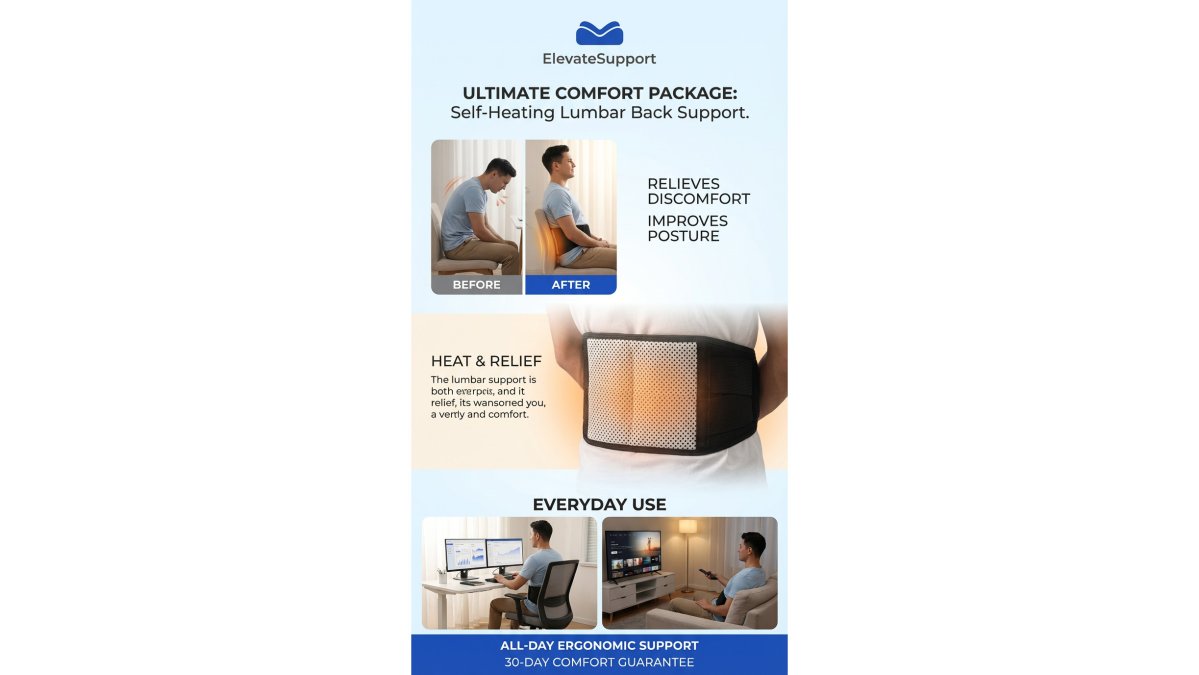
| Self-Heating Magnetic Lumbar Support Belt | £25.99 | Composite material | Lower back tension relief | Magnetic therapy + warmth |
| Adjustable Back Support Brace | £17.99 | Cotton + ABS | Posture correction | Upper back and shoulder support |
Best Lumbar Support Pillows: Our Top 5 Picks
Finding the right lumbar support pillow depends on your primary use and support level. ElevateSupport offers five options solving different sitting challenges.

1. Memory Foam Lumbar Support Pillow (£34.99)
This premium option suits relaxation, bed, sofa, or extended reading. The contoured design and soft memory foam provide cushioning without excessive firmness, with breathable fabric supporting all-night comfort.
The key advantage is versatility for relaxation use.
Best for: People prioritising comfort during rest and relaxation, those needing lumbar support for bed or sofa use, anyone seeking ergonomic support without the rigidity of a work-focused design.
What works: Ergonomic contoured shape, soft memory foam, breathable cover for extended wear.
What doesn't: No attachment mechanism for chairs, higher price point than comparable options, less suitable for dynamic sitting environments.
2. Ergonomic Lumbar Support Cushion for Office Chair & Car (£29.99)
This practical workhorse suits those splitting time between office and car. The adjustable strap keeps it firmly in place in both environments.
The memory foam provides adequate support without excessive firmness, with breathable material preventing heat buildup during long workdays.
The value proposition is one product working across office chair and car, eliminating the need for multiple cushions.
Best for: Office workers who also drive regularly, remote employees with multiple seating locations, anyone seeking a single solution for work and travel, professionals wanting straightforward ergonomic support.
What works: Dual-use functionality, adjustable strap keeps cushion in place, memory foam comfort, breathable fabric, mid-range pricing.
What doesn't: Less contoured than premium options, not ideal for extended relaxation use, adjustable strap requires proper positioning for optimal support.
3. Memory Foam Lumbar Support Cushion (£17.99)
At £17.99, this entry-point option features high-density memory foam and contoured shape maintaining spinal alignment. The adjustable strap keeps it positioned correctly throughout your workday.
Available in Chocolate, Pink, Sky Blue, Black, and Light Grey, the colour range encourages consistent use by matching workspace aesthetics.
Memory Foam Lumbar Support Pillow →
This versatile, affordable option handles office chairs, car seats, and home seating. Support remains adequate for everyday sitting discomfort.
Best for: Budget-conscious buyers, first-time users testing lumbar support effectiveness, office workers wanting everyday comfort, gamers sitting for extended periods, anyone seeking multiple colour options.
What works: Affordable pricing, high-density memory foam, adjustable strap, multiple colours, suitable for multiple seating environments.
What doesn't: Less premium contouring than higher-priced options, may require repositioning during very long sitting sessions.
4. Self-Heating Magnetic Lumbar Support Belt (£25.99)
This wearable belt provides lumbar support through magnetic therapy and self-heating fabric, warming the lumbar region gently to promote blood flow and ease muscle stiffness.
Designed for lower back tension and muscle tightness, the self-heating feature provides relief for muscle-based pain.
The adjustable design fits most adults and can be worn discreetly under clothing. However, it's less about structural spinal support and more about tension relief and warmth therapy.
Best for: People experiencing muscle tension and stiffness, those seeking thermal pain relief, office workers wanting discreet support, anyone interested in magnetic therapy approaches, individuals managing chronic lower back discomfort.
What works: Self-heating fabric provides warmth and relief, magnetic therapy embedded throughout, adjustable for most adults, wearable under clothing, addresses muscle tension specifically.
What doesn't: Less effective for postural support than traditional cushions, requires direct contact with skin for optimal heating, not ideal for pure spinal alignment needs.
5. Adjustable Back Support Brace (£17.99)
This brace targets upper back and shoulder posture, pulling shoulders back and addressing rounded-shoulder slouch from desk work. It supports thoracic and cervical spine, relaxing tense muscles and retraining posture.
The breathable, lightweight materials make it suitable for all-day wear, and the adjustable straps fit both men and women. Many users wear it discreetly under clothing at work. The posture correction benefit extends beyond sitting, it improves standing posture as well.
This isn't a lumbar cushion in the traditional sense, but it's worth considering if your primary discomfort stems from upper back and shoulder tension rather than lower back pain.
Best for: Desk workers experiencing upper back and shoulder tension, people with rounded-shoulder posture, students spending long hours studying, anyone wanting to improve overall spinal alignment, individuals seeking discreet posture correction.
What works: Supports thoracic and cervical spine, adjustable for most sizes, breathable and lightweight, suitable for all-day wear, improves both sitting and standing posture.
What doesn't: Doesn't provide lumbar support for lower back pain, requires consistent wear to retrain posture effectively, less suitable for people with severe postural issues requiring professional intervention.
Best Seat Cushion for Desk Chair: Finding Your Match
The best seat cushion depends on your specific chair type and sitting duration. Office chairs, gaming chairs, car seats, and home furniture all have different dimensions and support requirements. A cushion that works brilliantly in an ergonomic office chair might be incompatible with a low-backed gaming chair or a car seat with integrated lumbar support.
Start by measuring your chair's backrest width and depth. Most office chairs accommodate standard lumbar cushions, but gaming chairs with integral backrests sometimes conflict with external cushions. Car seats vary significantly, some have shallow backrests unsuitable for cushion attachment, whilst others provide ideal mounting surfaces.
Consider your sitting duration. If you're sitting four to six hours daily, a memory foam cushion with moderate density provides adequate support. Beyond six hours, higher-density foam and more pronounced contouring become increasingly important.
Durability, Compatibility, and Long-Term Value
Memory foam durability depends on density and quality.
Compatibility extends beyond initial fit. Your needs change over time. If you transition from office work to remote work, you might need a cushion that works equally well in a home chair and a car. If you develop chronic back pain requiring more specialised support, your entry-level cushion might no longer suffice. ElevateSupport's range addresses these transitions, starting affordable for testing, with premium options available as needs evolve.
Frequently Asked Questions
Do lumbar support pillows actually help with back pain?
Yes, lumbar support pillows reduce strain on the lower back by maintaining spinal alignment and distributing pressure evenly. They support the natural curve of your spine, which is critical for preventing sciatic nerve irritation and reducing muscle fatigue during extended sitting. Results vary by individual, but consistent use can help improve comfort and posture.
How should a lumbar support pillow be positioned on a chair?
Position the pillow at the small of your back, roughly at waist level, so it fills the gap between your lower spine and the chair. The contoured side should face inward toward your body. Use the adjustable strap to secure it firmly so it doesn't slip during the day. Proper positioning ensures the pillow supports your lumbar spine and maintains healthy pelvic tilt throughout your sitting periods.
Can I use the same lumbar support pillow in my office chair and my car?
It depends on the pillow design. The Ergonomic Lumbar Support Cushion for Office Chair & Car is specifically engineered for both environments with an adjustable strap that fits standard office chairs and car seats. Other models like the Memory Foam Lumbar Support Cushion also work in both settings. Always check the product details to confirm compatibility with your specific chair and vehicle seat.
What features should I look for in a memory foam lumbar cushion?
Look for high-density memory foam that maintains its shape without flattening after a few weeks, a contoured ergonomic design that follows your spine's natural curve, a breathable cover for all-day comfort, and an adjustable strap for secure positioning. Consider colour options if aesthetics matter in your workspace. Ensure the cushion fits your chair type and offers adequate firmness without feeling too rigid.