
Does Memory Foam Really Help Sciatica
Table of Contents
- What Memory Foam Can and Cannot Do for Sciatica
- How Pressure Relief and Body Contouring Address Sciatica Discomfort
- The Best Seat Cushion for Sciatica: What to Look For
- How to Sit With Sciatica: Positioning and Support Strategies
- Lumbar Support Cushion for Sciatica: Lower Back and Pelvic Alignment
- Memory Foam Mattress for Sciatica: Sleep Position and Firmness
- When to Seek Medical Advice and Red Flags
- Evaluating Whether Your Cushion or Mattress Is Actually Helping
- Frequently Asked Questions
Last Updated: October 5, 2026
What Memory Foam Can and Cannot Do for Sciatica
Memory foam has become a popular choice for people dealing with sciatic nerve pain, but does memory foam really help sciatica, and it's important to understand what it can actually deliver. The truth is more nuanced than marketing claims suggest.

Memory foam can provide comfort and pressure relief while you sit or sleep. It contours to your body shape, distributing your weight more evenly than a standard foam or firm surface. This may reduce pressure on sensitive areas like your tailbone, hips, and lower back.
What memory foam cannot do is treat the underlying cause of sciatica. A herniated disc, spinal stenosis, or other structural issues won't be fixed by a cushion or mattress. Memory foam addresses symptoms, not the root problem. Think of it as pain management, not a cure.
Many people find that the right memory foam product reduces discomfort during long sitting or sleeping periods. But relief varies widely depending on your specific condition, body type, and how severe your symptoms are. Some experience significant improvement. Others notice minimal change.
The key is managing expectations. If you have chronic sciatica diagnosed by a healthcare professional, memory foam can be part of your comfort strategy alongside physiotherapy, exercise, or medical treatment. It's a tool in your toolkit, not a standalone solution.
How Pressure Relief and Body Contouring Address Sciatica Discomfort
Pressure relief is where memory foam genuinely excels. When you sit on a standard chair or mattress, your body weight concentrates on specific points. Your tailbone, lower back, and hips bear most of the load. This creates pressure that can aggravate sciatic nerve pain.

Memory foam responds to body heat and weight. It softens under pressure and moulds to your shape. This spreading of pressure across a wider surface area reduces concentrated force on painful spots. Instead of pressure building in one area, it distributes more evenly.
Body contouring works similarly. As the foam shapes itself to your curves, it supports the natural contours of your spine, pelvis, and hips. For people with sciatica, this support can mean:
- Less strain on the lower back during sitting
- Better alignment of the pelvis and spine
- Reduced pressure on the sciatic nerve pathway
- Greater comfort during extended sitting or sleeping
However, the quality of memory foam matters significantly. Cheap, thin foam flattens quickly and loses its contouring properties. Premium memory foam maintains its shape longer and provides consistent support night after night.
At ElevateSupport, we use premium memory foam designed for comfort-focused support.
The Best Seat Cushion for Sciatica: What to Look For
Choosing the right seat cushion for sciatica requires looking beyond brand names and marketing. Focus on these practical features:
Shape and contour. Look for a cushion with a contoured design, not a flat rectangle. A lumbar support cushion should curve to fit your lower back. A seat cushion should have a shape that supports your hips and tailbone without putting pressure on the sciatic nerve pathway.

Foam density. Higher-density memory foam resists flattening. If a cushion feels too soft or squishy, it will compress under your weight and lose effectiveness within weeks. Medium to medium-firm density is ideal for most people with sciatica.
Height and thickness. A cushion that's too thin won't provide adequate support. A cushion that's too thick can tilt your pelvis in ways that worsen discomfort.
Portability. If you work in an office, commute, or travel, you need a cushion you can move between locations. Lightweight memory foam cushions with handles or straps are practical for this.
Non-slip base. Your cushion should stay in place on your chair or car seat. A non-slip bottom prevents sliding and keeps support consistent.
Our Memory Foam Seat Cushion (£16.99) is ergonomically shaped and includes a non-slip base. Many people use it at their desk, then move it to their car for the commute home. The lightweight design makes this realistic.
For tailbone-specific pressure relief, the Central-Groove Memory Foam Seat Cushion (£22.99) adds a central groove that reduces direct pressure on the tailbone while supporting proper spinal alignment.
How to Sit With Sciatica: Positioning and Support Strategies
Sitting position matters as much as cushion choice. Poor posture cancels out the benefits of even the best memory foam support.
Keep your back straight. Slouching curves your spine and increases pressure on the sciatic nerve. Sit upright with your shoulders relaxed. Your ears should align roughly with your shoulders.
Position your hips correctly. Your hips should be higher than your knees, or at least level with them. If your chair is too low, add a cushion to raise your seating height.
Place your feet flat. Both feet should rest flat on the floor or a footrest. Crossing your legs or tucking them under you twists your pelvis and worsens sciatica symptoms.
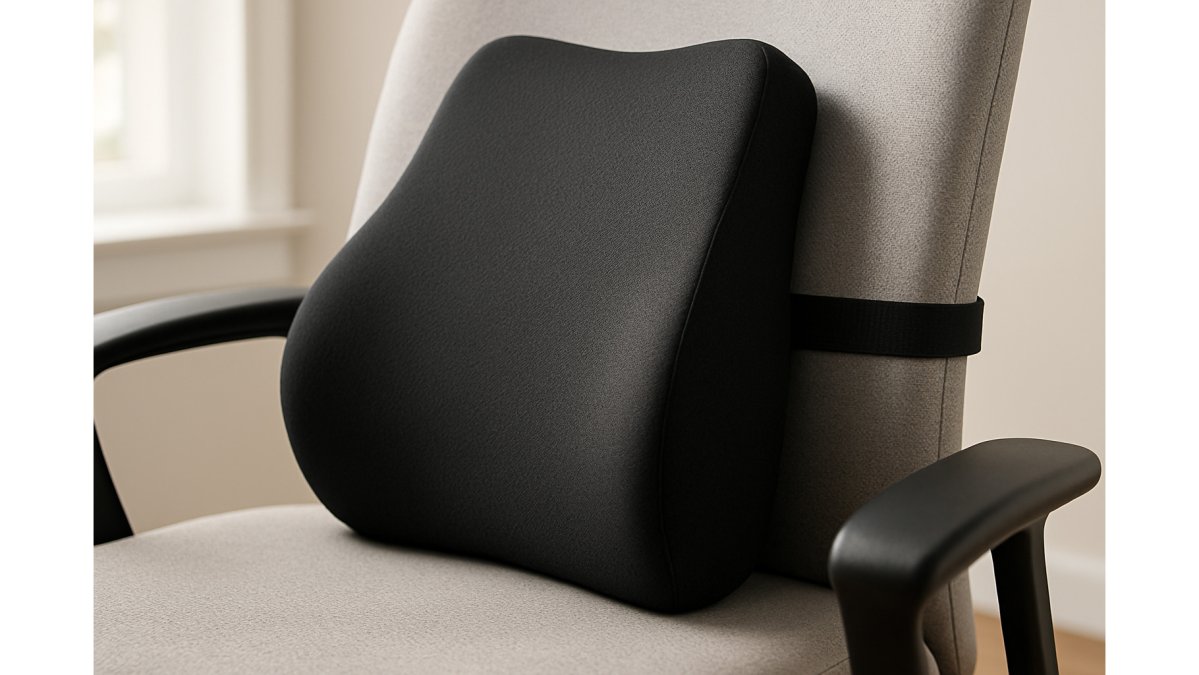
Support your lower back. This is where a lumbar support cushion becomes essential. The Memory Foam Lumbar Support Cushion (£17.99) sits against your lower back and maintains the natural curve of your spine.
Take regular breaks. Even with perfect posture and support, sitting for hours without movement is problematic. Stand, walk, or stretch every 30-45 minutes. This prevents stiffness and reduces nerve compression.
Adjust your desk and screen. Your monitor should be at eye level. Your keyboard and mouse should be at elbow height. Poor ergonomics force you into compensatory positions that worsen sciatica.
Lumbar Support Cushion for Sciatica: Lower Back and Pelvic Alignment
A lumbar support cushion targets the specific area where sciatica often originates: your lower back and pelvis. Unlike a general seat cushion, a lumbar support cushion is contoured to support the curve of your lower back.
Your lower back naturally curves inward. When you sit on a flat surface, this curve flattens. Flattening puts stress on your lower back muscles and increases pressure on the sciatic nerve. A lumbar support cushion restores that curve.
Memory Foam Lumbar Support Cushion →
Pelvic alignment is equally important. Your pelvis is the foundation for your spine. If it tilts forward or backward, your entire spine compensates, increasing nerve pressure. A properly designed lumbar cushion supports both your lower back curve and keeps your pelvis in neutral alignment.
Look for a lumbar support cushion with these features:
- Contoured shape that fits the natural curve of your lower back
- Height that reaches from your mid-back to your lower back
- Firmness that supports without feeling rigid
- An adjustable strap to keep it positioned correctly on your chair
The Memory Foam Lumbar Support Cushion uses a contoured design and includes an adjustable chair strap. This keeps it in place whether you're shifting positions or moving between chairs. The strap is essential because a cushion that slides out of position loses its effectiveness immediately.
For bed support, the Memory Foam Lumbar Support Pillow (£34.99) provides similar benefits while you sleep or rest. It supports the natural curve of your lower back and helps maintain spinal alignment throughout the night.
Memory Foam Mattress for Sciatica: Sleep Position and Firmness
Your mattress plays a major role in sciatica comfort. You spend roughly one-third of your life in bed. A mattress that doesn't support your spine properly will aggravate symptoms all night.
Sleep position matters. Side sleepers should place a pillow between their knees to keep their pelvis aligned. Back sleepers should place a pillow under their knees to support the natural curve of their lower back. Stomach sleeping is generally worst for sciatica because it twists your spine.
Firmness affects alignment. A mattress that's too soft sinks under your weight, allowing your spine to curve excessively. A mattress that's too firm doesn't contour to your body, creating pressure points. Medium-firm is ideal for most people with sciatica.
Memory foam mattresses work well for sciatica because they:
- Contour to your body shape without excessive sinking
- Distribute pressure evenly across your entire body
- Support the natural curves of your spine
- Reduce motion transfer if you share a bed
However, a mattress alone won't solve sciatica. Combine it with proper sleep positioning, the right pillows, and daytime support strategies. Many people see the most improvement when they address both sitting and sleeping comfort.
When to Seek Medical Advice and Red Flags
Memory foam and cushions are helpful tools, but they're not substitutes for medical care. Certain symptoms require professional evaluation.
Seek medical advice if you experience:
- Severe pain that doesn't improve with rest or over-the-counter pain relief
- Numbness or tingling that spreads or worsens
- Weakness in your leg or foot
- Loss of bladder or bowel control
- Pain after an injury or accident
- Symptoms that persist beyond six weeks
These could indicate a serious underlying condition like a herniated disc, spinal stenosis, or nerve compression that needs professional treatment. Physiotherapy, medical imaging, or other interventions may be necessary.
Also see a healthcare professional if you're unsure whether your symptoms are actually sciatica. Lower back pain has many causes. Proper diagnosis ensures you're treating the right problem.
Memory foam provides comfort and symptom relief, but it addresses discomfort, not disease. If your symptoms are severe or persistent, professional evaluation is essential.
Evaluating Whether Your Cushion or Mattress Is Actually Helping
After you've purchased a memory foam cushion or mattress, how do you know if it's actually making a difference, and does memory foam really help sciatica for your specific condition?
Track your symptoms over two weeks. Note your pain level each day on a simple scale (1-10). Track how long you can sit comfortably before discomfort starts. Note your sleep quality.
Assess your daytime comfort. Can you sit at your desk for longer periods without pain? Do you feel less stiffness when you stand up? Are you taking fewer pain-relief breaks?
Evaluate your sleep quality. Are you waking with less lower back pain? Can you sleep in your preferred position without waking? Are you sleeping longer without interruption?
Notice pressure points. Does your tailbone, lower back, or hip feel less pressured? Are you experiencing fewer pressure-related aches? Reduced pressure point discomfort is a clear sign the product is working.
Be realistic about timing. Your body needs time to adapt to new support. Give a new cushion or mattress at least two weeks before deciding it's not helping. Some people feel improvement within days.
Consider other changes. If you've also started stretching, exercising, or adjusting your posture, these factors contribute to improvement too. Memory foam is one part of a broader strategy.
If after four weeks you see no improvement or your symptoms worsen, the product may not be right for you. Different people respond differently. A cushion that helps one person might not help another.
Memory foam can reduce discomfort and improve your sitting and sleeping experience when you have sciatica. Explore our range of lumbar support and seat cushions to find the right fit for your needs. Shop Comfort and experience how proper support can make your day more comfortable.
Frequently Asked Questions
Does memory foam really help sciatica pain?
Memory foam can reduce discomfort from sciatica by relieving pressure on the sciatic nerve and supporting proper spinal alignment, especially when sitting or sleeping. However, it addresses symptoms rather than the underlying cause of sciatica, such as a herniated disc or spinal stenosis. Many people find that combining memory foam support with targeted positioning and medical advice produces better results than either approach alone.
What's the difference between a lumbar support cushion for sciatica and a regular seat cushion?
A lumbar support cushion for sciatica is contoured to support the lower back and maintain the spine's natural curve, reducing pressure on the sciatic nerve. A standard seat cushion focuses on overall hip and tailbone comfort. For sciatica relief, a lumbar-specific design that cradles the lower back, like the Memory Foam Lumbar Support Cushion, addresses the root of discomfort more effectively than general cushioning.
How should you sit when you have sciatica?
Sit with your feet flat on the floor, knees at a 90-degree angle, and your back against a lumbar support that maintains the spine's natural curve. Keep your hips level and avoid slouching or leaning forward. Use a memory foam cushion to reduce pressure on your tailbone and hips. Take regular breaks to stand and stretch, especially during long work sessions or car journeys.
Should I buy a memory foam mattress or a cushion for sciatica relief?
Both can help, depending on when your discomfort is worst. If sciatica flares when sitting, at your desk, in the car, or gaming, a seat or lumbar cushion provides targeted relief. If pain worsens at night or when lying down, a medium-firm memory foam mattress supports spinal alignment during sleep. Many people benefit from using both: a cushion for daytime activities and a supportive mattress for night-time comfort.